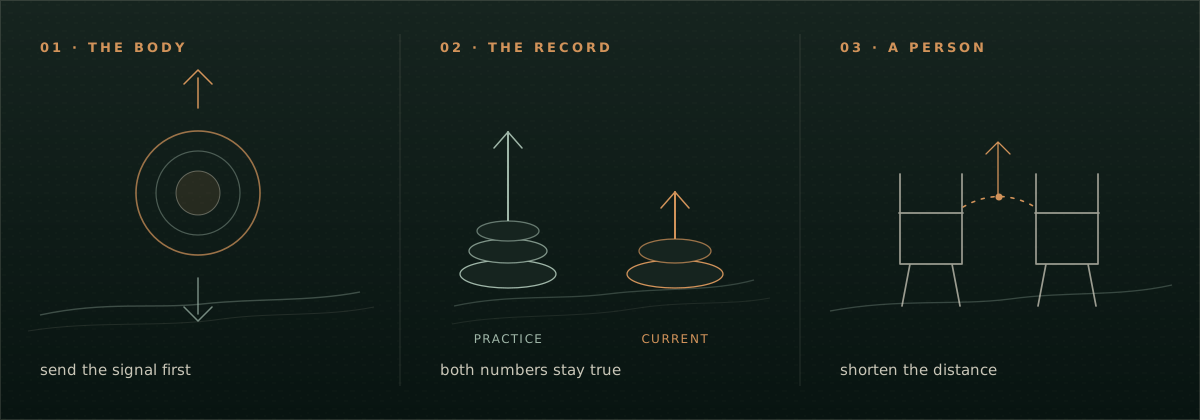
Marrow is built for the long middle, where nothing is on fire and nothing feels like progress either. This page is the whole of it: what each part is for, what actually happens inside it, and how well the evidence under it really holds. Three of the pieces run right here, with nothing to install.
Not a video, not a screenshot tour. A taste of the craving tool, a real surge with its real timings, and the first thirty seconds of a rehearsal. Nothing here is saved anywhere, and nothing asks you for a name.
the pull, in miniature
How strong is the craving?
5
here, but you came anyway
barely thereall of me
breathe in
it is a wave, not a wall
It is already cresting. Nothing to do but breathe and let it move through.
after the wave
2
It came down. The craving crested and let go, and you did not feed it. That is the whole practice, and you just did it.
A taste of the real tool. In the app it stays open as long as you need, with no timer, and it ends by offering to keep one line for next time.
a surge, run hereno install, nothing saved
Pick by the moment, not by the menu.
A surge is a short paced sequence with a named mechanism and an honest label for how well the evidence holds. There are twelve in Marrow. Three of them run on this page, with the real beats and the real timings. Choose the one that matches where you actually are.
If this is bigger than a technique, go straight to a person. Call or text 988, any hour, free and confidential.
in the headgood60 seconds
Name It
The feeling gets smaller the moment it has a name.
Putting a feeling into words moves activity away from the alarm part of the brain and back toward the part that plans and reasons.
goodLabelling an emotion reduced amygdala response and raised prefrontal activity in brain imaging work.Lieberman et al., Putting Feelings Into Words, Psychological Science, 2007.See the source
6
loud
goneall of me
Bigger than a technique? Call or text 988, any hour.
name itbeat 1 of 5
Stop what you are doing. Put your feet flat.
One minute. That is the whole ask.
60 seconds left
Crisis help does not wait for this to finish. Call or text 988, any hour.
after
Where is it now?
Same scale. Honest is more useful than hopeful, and a surge that did nothing is information about the surge.
Notice whether it got smaller, or only clearer. Either one is worth having.
Nine times out of ten it is not a craving. It is that I am hungry and I have not spoken to anyone all day.
three years
Nothing you just did was saved. Inside Marrow it would be. The app keeps that before and after pair on your device, and once you have three rated runs of the same surge it tells you what that one does for you and when it lands hardest. Then it hands you your own best move instead of a generic tip. The read rates the surge, never you.
Still loud? That happens, and it is not a failure. Call or text 988, or SAMHSA at 1-800-662-4357, any hour.
it is not helping
Then it is the wrong tool tonight.
That is worth knowing, and it is not a failure of yours. No single move is right for every moment. Here is where to go instead.
If this has turned into danger
Stop here and reach a person. The 988 Suicide and Crisis Lifeline is free and confidential, any hour, by call or by text. If you might be in physical danger right now, call 911.
Something colder and faster may land better. The Dive puts cold water on your face and drops your heart rate in under a minute through a reflex, not through willpower. Riding the Wave takes ten to twenty minutes and does not ask you to change anything at all.
Practice the hard thing before you are standing in it.
You know the room that is coming. The wedding with the open bar. The parent who keeps pushing. The friend who texts at midnight and is funny about it. In Marrow you name that room, and Marrow plays the other side so you hear your own words come out of your own mouth now, instead of composing them under pressure later.
What follows is a scripted taste, two exchanges long. In the app the other side responds to what you actually say, it runs for eight exchanges at most, and the whole thing sits on your device.
It pushes once, the way a real person does. It does not push twice.
It never makes the drink or the drug sound good. Not once, not in passing.
It stops being a character the second anything real comes up, and hands you a person.
Eight exchanges, counted on screen, then the scene ends on its own.
Step out sits on the screen the whole time. One tap, no questions.
It is not a clinician, a sponsor or a counsellor, and it gives no medical advice.
It is not a person. Nothing you say in here is scored, and nothing is sent anywhere.
Pick a room to step into.
exchange 1 of 8 · this taste runs two
a guest who keeps offering
There you are. Here, I got you one. Everyone is having one.
you said
Your words stay in this browser tab and go nowhere. A safety check runs on them here, before anything else happens, exactly as it does in the app.
the scene is over
You said it once. Next time is a repeat.
That is most of what a rehearsal is for. Under pressure people compose badly, and a sentence you have already said out loud is a sentence you can remember instead of invent.
the line worth keeping
In Marrow this is where a short read lands: what held, the one line worth keeping, and an offer to save it as a guardrail. A saved guardrail goes and waits in The Pull, and comes back on its own when that hour is near. Nothing is graded, and the pressure you were answering is never stored, only your own words.
What you just said is bigger than a rehearsal, and you deserve a real person tonight. The 988 Suicide and Crisis Lifeline is free and confidential, any hour: call or text 988. If you might be in physical danger, call 911. Please reach a person first. Nothing you said here is being held against you, and nothing was stored.
The same two checks run in the app, on your device, before the scene ever reaches a server. A real thing said inside a practice scene is never left waiting on a network.
the parts
Twelve doors, and what each one is for.
Each one below says what the moment feels like before you open it, what actually happens inside, the mechanism underneath with an honest label for how well it holds up, and one line from someone who uses it. Where the evidence is thin, it says thin.
right now
The Pull
A craving does not ask permission and it does not negotiate. It arrives at full volume and tells you it will never stop. It always stops.
You give it a number, then the screen slows down. Paced breathing, then the techniques in sequence: watching where it actually sits in your body, naming it, grounding, playing the hour after it honestly. There is no timer and no countdown you have to beat. It stays open as long as you need it.
At the end you rate it again, and whatever the second number is, it goes in as information. Then Marrow offers to keep one line from the way through, in the form "when X, then Y". That line goes and waits, and it comes back on its own the next time that hour is near.
good evidenceurge surfing
Urge surfing means watching the craving without acting on it, so it crests and falls instead of climbing forever. It sits inside a relapse-prevention model that has been studied for decades.
The relapse-prevention model from Marlatt and colleagues, and urge surfing within mindfulness-based relapse prevention. See the source
The lie is that it keeps climbing forever. I started timing them out of spite. The longest one was twenty six minutes.
eleven months
right now
Surgesnew
You do not need advice. You need one thing to do with your hands in the next ninety seconds, and you need to know whether it actually does anything.
Twelve surges. Each one is a paced sequence, not a tip: a named mechanism, a run time from thirty seconds to twenty minutes, beats that hold for as long as they need, original art that moves with the breath, and an evidence label that is never rounded up. They sort into three kinds. In the body: the sigh, the dive, five things, the butterfly, ten minutes moving, the long exhale. In the head: riding the wave, name it, play it forward, just a thought, the if-then. With other people: the refusal.
The labels are the point. strong means a randomised trial or a large meta-analysis. good means a real, established literature. promising means early. practice means it is used everywhere in crisis and trauma work and it costs nothing, and no trial has tested it. Five Things is labelled practice, and it stays labelled practice, because a person deciding at 3am whether to trust this deserves to know which is which.
Then the part no other recovery app does. Every run can log how loud it was before and after, on your device only. After three rated runs of the same surge, Marrow tells you what that one actually does for you: the dive takes you down about 3 points in a minute, and it is your steadiest one. It builds your own ranked order, notices which hour a surge lands hardest in, and hands Heron your best move instead of a generic one. Generic coping advice becomes a personally measured protocol.
practice-based, not trial-testedthe personal read
Marrow watches which surges actually bring your number down, and shows you your own order. That is measurement of you, on your device, not a trial result, and we are not going to dress it up as one.
Each surge carries its own evidence, listed one at a time. See the source
I keep a metal spoon in the freezer. Sounds stupid. It has got me through more nights than anything I paid for.
Some days there is nothing to report. You got up, you did not use, nothing happened. Marking that feels pointless right up until you look back and see forty of them.
The check-in takes under a minute and accepts a bad answer. Fog is an answer. Flat is an answer. There is no minimum and no perfect week to protect.
Marrow keeps two numbers and never one. Days in Practice counts every day you have done this and only ever rises. Days in this stretch describes where you are standing right now. If you return to use, the first number does not move, because it would be a lie if it did. The second one starts again at one, because that is simply true. Only you can log a return. Marrow never infers one from your behaviour, your silence or your typing.
good evidenceself-monitoring
Recording a behavior honestly, day after day, starts to change the behavior on its own, before anything is added to it. It is one of the steadiest findings in behavior change.
Self-monitoring, a standard component of behavioral treatment across substances. See the source
promising, early evidencewhy nothing resets
Shame after a return tends to predict a harder, longer return. Guilt about the act does not do the same thing; shame about the self does. That is why nothing here ever resets to zero.
Research on shame and relapse in addiction. Consistent, but a smaller literature than the coping work. See the source
The number I care about is the one that never goes down. I returned twice. Both times the practice count just kept counting, and that is the only reason I came back at all.
a year and a half
right now
The Grove, and reaching a person
Reaching a person is the most protective thing in this, and it is the thing that feels hardest to do. The dread of having to explain yourself is almost always bigger than the explaining.
Three routes, in the same place. Anonymous, moderated rooms where you can read for eleven days before you say anything. A meeting finder that goes straight out to AA, NA, SMART Recovery and Refuge Recovery, because a room with people in it beats an app. And a phone number a human answers: 988 any hour, and SAMHSA at 1-800-662-4357, free and confidential.
If the asking is the hard part, The Refusal takes three minutes and puts your actual sentence in your mouth first. Crisis help is never behind a menu, a scene or an overlay. It is one tap from every screen in the app and every page on this site.
good evidencewhy one named person matters
The most dangerous window is often short. Among people who survived an attempt, most described very little time between the decision and the act. Having one specific person already named, and already reachable, is what fills that window.
Deisenhammer and colleagues, 2009, on how brief the highest-risk window often is. See the source
promising, early evidencepeer rooms specifically
Peer support tracks with better outcomes across recovery research, but the studies vary a lot in quality and design. It is a real effect with a soft edge, and we will not call it more than that.
Peer recovery support research. Growing, uneven, not settled. See the source
I sent three words. Bad night, awake. He called inside a minute. I had built the whole thing up into a speech I was going to have to give.
two years
any hour
Heron
Talking to something that is not a person is a strange thing to find useful. It is useful mostly because it is awake at 3am and it does not get tired of you.
Heron asks the next true question and does not rush to fix. It never diagnoses. It never gives medical, dosing or detox advice, and it says out loud that it is not a person, not a clinician and not a sponsor. It reads your own surge history, so when it suggests something it can suggest the one that has been working for you rather than a generic tip.
A safety check runs on your words the instant you send them, on your device, before anything else happens. So the response that protects you never waits on a model. If you say something about suicide, self-harm or overdose, Heron stops everything, stays warm, and hands you to 988. Conversations are session-only and are not used to train models. The key that powers Heron stays on the server and never touches your browser.
practice-based, not trial-testedthe honest position
There is no trial showing that talking to an AI companion helps someone stay in recovery. Heron is built out of things that do have evidence, and it is built to hand you to a real person fast, but the companion itself is untested. That is the honest position.
Practice-based. Not trial-tested, not therapy, and not a clinician. See the source
It is not a person and I do not want it to be. I want it to be there, and to not flinch.
eight months
before it happens
The Rehearsalnew
You already know which room is coming. You have run the conversation in your head forty times and it still comes out wrong, because you have never once said it out loud.
You name the situation in your own words. Marrow plays the other side: the guest who keeps offering, the parent who will not let it go, the old friend at midnight, the colleague at the work dinner, the person you are telling for the first time, the doctor asking how much you drink. Then a short read at the end. What held, the one line worth keeping, and an offer to save that line as a guardrail, which goes and waits in The Pull like every other one.
The guardrails are built into the interface, not just written into a prompt. It is visually and verbally not Heron, with a band across the top that says practice and never scrolls away. Step out is on screen in every state and ends the scene on the first tap, with no confirmation. It pushes once, the way a real person does, and then it yields. It never makes the substance sound good, not once and not in passing. Eight exchanges, counted on screen, and then it stops on its own. The crisis and use checks run on every line on your device, before the network is involved at all. And it breaks character completely on any real distress and hands you to a person.
Your own lines are kept so you can read them again. The pressure you were answering is never kept, and a scene that tripped a safety check is not stored at all, because nobody should open a list and be handed back their worst minute.
good evidencebehavioural rehearsal
Saying the words out loud in advance is refusal-skills training, a standard component of the behavioural treatments for substance use that hold up well in trials. Under pressure you compose badly; the moment should ask you to remember something, not invent it.
Refusal-skills training within behavioural treatment. See the source
I practised in the car outside the wedding. Felt ridiculous. Said it four times that night without thinking about it once.
seven months
after a return
The return debriefnew
The morning after. You are already writing the story where this proves what you always suspected about yourself, and the story is doing more damage than the night did.
Only after you log a return, and only ever by your own hand, Marrow offers to look at it with you. Never required. Never opened for you. If you say not now, the offer disappears and nothing at all is written down.
If you take it, it does three things and stops. It lays out the chain, the hours and states that set the ground long before the decision. It finds the earliest fork, the first point where a different move was still available and it did not feel like a choice yet, which is nearly always much earlier than it feels. And it offers one guardrail worth keeping, in the same when-X-then-Y form as every other one, which you can keep or decline. There is no grade, no post-mortem language, and no blame anywhere in it. The worst day becomes the most useful data you own.
promising, early evidencewhy the tone is the mechanism
Shame after a return tends to predict a harder, longer return. Guilt about the act does not do the same thing; shame about the self does. A debrief that reads as an accusation would make the thing it is meant to help worse.
Research on shame and relapse in addiction. Consistent, but a smaller literature than the coping work. See the source
The first app I used reset me to zero. I deleted it that night and did not come back to any of this for four months.
a year, twice
a few days at a time
Crossings and guides
The hard moment is not really the problem. The problem is deciding what to do inside the hard moment, while it is happening, with a brain that is already busy.
A crossing is a guided way across one hard stretch you can see coming: the wedding, the first Christmas, the flight, the funeral, the empty Saturday. You walk it beforehand and come out the other side with the moves already decided, so on the day you are remembering rather than improvising.
A guide is longer. A few minutes a day for several days, for the things that do not come apart in one sitting: grief, resentment, the flatness that turns up around month five, the first two weeks. You can put one down halfway through and pick it up nine weeks later, and it will be exactly where you left it. Nothing expires and nothing nags.
strong evidencepre-deciding the move
Deciding the exact moment and the exact move in advance, in the form when X, then Y, raises follow-through sharply compared with intending to do it in general. This is one of the best supported findings in behavior change.
Implementation-intentions research from Gollwitzer and colleagues, with large meta-analytic support. See the source
practice-based, not trial-testedthe multi-day guides
The material inside these guides draws on established therapy ideas, but a multi-day guide in an app has not been tested as a whole. We are calling it what it is: written practice, not a trial result.
Practice-based. The individual pieces carry their own evidence. See the source
I wrote the wedding one out three days early. On the day I did not have to think. I just did the thing I had already decided.
eighteen months
at your pace
The steps, walked your way
The steps are older than every study about them, and people argue about them constantly. They are also the most walked path out of this that exists.
You can walk the twelve in Marrow's own plain words, guided roughly the way a sponsor would, with no copyrighted literature reproduced anywhere. Step four can take five months and nothing will hurry you. If the god parts are not for you, switch to a secular track built on the same cognitive and behavioural tools, and cover the same ground without the language.
Both tracks keep turning you back toward a real meeting and a real person, because that is where the evidence actually is.
good evidencetwelve-step facilitation
A 2020 Cochrane review found Alcoholics Anonymous and twelve-step facilitation performed as well as other established treatments for alcohol, and better on continuous abstinence. That evidence is for meetings and facilitation with people, not for working steps inside an app.
Cochrane review of Alcoholics Anonymous and twelve-step facilitation, 2020. See the source
I did not believe a word of the god parts. I did the work anyway and the work did something. Those turned out to be two separate questions.
four years
over months
Standing
Six months in, people ask how you are doing and you genuinely do not know. Nothing dramatic has happened either way, and a day count does not answer the question.
Standing is an occasional reading of the ground under you rather than a score of you: your people, your health, your meaning, your coping. Ten short readings drawn from the domains behind a validated measure of recovery capital, written in Marrow's own words rather than the copyrighted scale text.
It comes back as a warming river, not a number, and its whole job is to be something you can watch grow across months. It survives a return completely untouched, because the ground under you does not vanish on a bad night.
good evidencerecovery capital
Recovery capital, the sum of the resources a person has to draw on, is measurable and tracks with how recovery goes. The brief scale it is drawn from has been validated. How Marrow shows it back to you is a design decision, not a trial result.
Vilsaint and colleagues, validation of the Brief Assessment of Recovery Capital, 2017. See the source
The stretch number matters less to me every year. The practice number is the one I actually feel.
six years
on the bank
Kin, for loving someone still using
Loving someone who is using is its own kind of exhausting. You are not the patient here, and you are not fine either.
Kin is the part of Marrow for the people standing on the bank. You did not cause it, you cannot control it, you cannot cure it, and your own exhaustion is real and belongs to you. It will not tell you to leave and it will not tell you to stay. It helps with the specific things: the boundary you keep failing to hold, the sentence you have to say out loud, the checking that takes your whole day and changes nothing, the question of what to do with your own life while this is happening.
Heron talks differently here. Every surge is still available to you, because your nervous system is having a hard year too.
good evidenceCRAFT
Community Reinforcement and Family Training teaches the people around someone who is using how to change what they themselves do. It gets more people into treatment than confrontation or detachment, and it measurably improves the wellbeing of the family member whether or not the person goes.
CRAFT, developed by Robert Meyers and colleagues. See the source
I checked his location eleven times a day. It never once changed the outcome. It only took the day from me.
his mother
before sleep
The evening
The day does not end because you stopped moving. Setting it down is something you do on purpose, or it follows you into bed.
A short pass before sleep. What the day was. A check on the four states that quietly take the floor out from under people, hungry, angry, lonely, tired, because most nights at least one of them is doing more of the work than the craving is. One good thing, if there is one, and some nights that is honestly just that the shower was hot. Then usually one long exhale, and that is it.
practice-based, not trial-testedhungry, angry, lonely, tired
Hungry, angry, lonely, tired is a workshop tool, not a tested instrument. It survives because it keeps being right about the states that quietly take the floor out from under people.
Practice-based, in wide use across recovery programs. See the source
One good thing, most nights. Some nights it is honestly just that the shower was hot. It still counts.
five months
the honest record
A return does not erase the work.
247
Days in practice
12
Days, this stretch
The practice still counts, all 247 days of it. Today is simply day 1 of this stretch. Nothing was taken away, and nothing needs earning back. If you want it, Marrow will look at how it went with you. If you do not, the offer disappears and nothing is written down.
the day-61 problem
What a resetting counter does to a person.
This is an argument with a mechanism, not with anyone's product. A streak counter is a good piece of design for a lot of things. Flossing. Language lessons. Running. The disagreement is narrow, and it is entirely about what the counter does on the day it breaks.
day 61, resetting counter
0
Sixty days of your life, gone from the screen
You drank on Tuesday. On Wednesday morning the app says zero. The sixty days are not stored anywhere you can see, so the only story the screen can tell you is that you were doing well and now you are not.
That story has a name in the relapse literature: the abstinence violation effect. The reaction to a lapse predicts whether it becomes a long return, often more than the lapse itself does. A counter that resets is a machine for producing exactly that reaction, at the exact hour a person is most exposed to it.
And the shame it produces is not neutral. It tends to predict a harder, longer return. So the most common thing to do next is not to try harder. It is to delete the app, which removes the only structure that was there.
day 61, marrow
61 & 1
Both true, and neither one a punishment
Days in Practice reads 61 and keeps counting. Every one of those days happened and none of them are undone. Days in this stretch reads 1, because that is simply where you are standing, and Marrow will not pretend otherwise either.
Nothing is confiscated. Standing does not move, because the ground under you did not vanish on a Tuesday. Your guardrails, your kept lines and your surge history are all still exactly where they were, and they are the things that will actually be useful this week.
Then, only if you want it, the debrief: the chain that led there, the earliest fork where a different move was available, and one guardrail worth keeping. The worst day turns into the most useful data you own, instead of a reason to close the app for four months.
To be fair to the streak: for a lot of people it works, and for the first thirty days the pressure of the number can genuinely help. Marrow is not built for those thirty days. It is built for year three, when the number has stopped meaning anything and the Tuesdays are the whole problem, and for the morning after, when what a person needs is a way back in rather than a scoreboard telling them they are at the beginning again.
free and private
No account. Nothing to sign up for.
Open it and start. Your check-ins, your surge runs, your rehearsals and your guardrails stay on your device, and stay yours. They are not sold and not used to train anyone. You can export all of it, and you can wipe all of it, in one tap.
Healing is never behind a paywall here, because the moment you need help should never be the moment you are asked to pay.
Yes, and there is no paid tier holding the useful parts. The moment you need help should never be the moment you are asked to pay.
Do I need an account?
+
No. There is no sign-up, no email and no password. You open it and start. Your record lives on your device.
Is Marrow therapy or a crisis service?
+
No. Marrow is a peer-support companion. It is not therapy, not medical care and not a crisis service. It is built to sit beside real care and to hand you to a real person the moment that is what you need. Crisis help is one tap from every screen and every page: call or text 988, any hour.
What happens if I return to use?
+
Nothing resets. Days in Practice keeps every day you have done. The current stretch starts again at one, because that is simply true. Marrow then offers an optional debrief, and declining it leaves nothing behind. A return is part of the work, and it is never treated as a failure.
Where does my data go?
+
Your check-ins, surge runs, rehearsals and guardrails stay on your device. They are not sold and not used to train models. Heron conversations are session-only. You can export everything and wipe everything. The full detail is in the privacy policy.
What is a surge?
+
A short paced sequence you run in the moment, with a named mechanism and an honest label for how well the evidence holds. There are twelve, from thirty seconds to twenty minutes. After three rated runs of the same one, Marrow tells you what that surge does for you specifically. See all twelve.
Is the AI companion pretending to be a person?
+
No. Heron says plainly that it is not a person, not a clinician and not a sponsor. It never diagnoses and never gives medical advice. A safety check runs on your words before anything else, so the response that protects you never waits on a model.
Is the Rehearsal safe if I am having a hard night?
+
It is built to get out of your way. Step out is on screen in every state and ends the scene on the first tap. The crisis and use checks run on every line on your device before the network is involved, and any real distress ends the character immediately and hands you to a person. If tonight is already hard, do not rehearse. Ride it, or call someone.
Can I use Marrow if I do not do meetings or the steps?
+
Yes. The steps are one track and a secular, SMART-style track sits beside them. The surges, the record, the guides and the Grove do not assume any program at all.
Is there anything for someone who loves a person still using?
+
Yes. Kin is built for the people on the bank rather than in the water. It draws on Al-Anon ideas and on CRAFT, which teaches family members to change what they themselves do, and it never tells you to leave or to stay.